A town near Exeter, known as Torquay, reportedly has quite an impressive aviary, so Will and I set out to see it today. Our train ride took around 45 minutes and was filled with beautiful views of water and countryside.
The aviary is about a 25 minute walk from Torquay's train station, so we were able to see a lot of other interesting sights on our walk to it, including the city's beautiful beach, Torre Abbey Gardens, and Princess Gardens. We even saw some workers scaling the side of a cliff.


By the time we reached the aviary, we were really hungry, so we stopped at a pub called The Tudor Rose for lunch. Will ordered soup and a roll, and I had a BLT. I had forgotten that the British idea of bacon is more like Canadian bacon than American bacon- a mistake that I hope I will not repeat. Nevertheless, my sandwich wasn't bad for a ham sandwich- it just wasn't what I was expecting.


After lunch, we finally made it to the aviary, which is called Living Coasts. The exhibits began with a children's film on the extinction of a great auk, in which the last two great auks in existence are named Gertrude and Gabriel. After they are killed, Gabriel comes back as "the auk angel Gabriel" and explains to the hunter that he should have taken them to Living Coasts rather than killing them. Needless to say, we found this film underwhelming, though it is probably reasonably effective at helping children understand the purpose of the aviary and its breeding program.


The rest of the aviary, however, was quite enjoyable. It contained a variety of different birds, including penguins and puffins. Some of the birds were free-flying, while others were restricted to enclosures.


The penguins' enclosure was particularly interesting, because it was deliberately designed so that the penguins can get out and walk around if they wish. In fact, the penguins have two different play areas which are separated by a walkway that runs right across the humans' sidewalk. The barriers are designed to keep people out rather than penguins in! When we walked by the habitat the first time, the penguins showed little interest in venturing out. However, when we returned at feeding time, quite a few penguins came out to get food and to visit the other play area.


In addition to birds and plant life, Living Coasts has two newly acquired South American seals. While we were there, one of the seals spent the entire time sunning itself on a rock, while the other frolicked in the water.


Living Coasts also has numerous interactive children's learning areas, which include games and other activities. Will particularly liked the climbing wall. From is aviary, it is also possible to get a great view of Tor Bay.


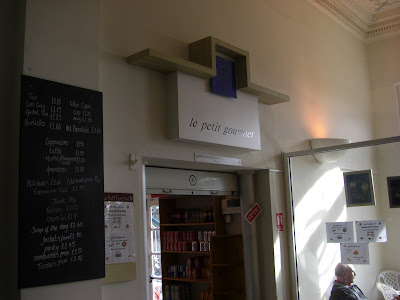
After leaving Living Coasts, Will and I roamed around for a couple of hours further exploring the city. Since today is "Red Nose Day," a fundraising day for the charity Comic Relief (whose slogan is "Do something funny for money"), we saw several money-raising efforts. One shop we visited provided snacks in exchange for donations to Comic Relief, and some of the snacks had little "red noses"! We also saw an old ocean mine and a gorgeous Anglican Church, visited the marina, and drank a milkshake at a local coffee shop, "Le Petit Gourmet". Surprisingly, here, a milkshake does not necessarily contain ice cream and may simply be flavored milk. Fortunately, we were warned of this in advance and were able to order a "super shake" which did contain ice cream. However, the ice cream was not blended into the milk, so it could better be described as a "milk float" than an American-style milkshake. It still tasted good, though, and it made for an interesting cultural observation.